 There has been a general trend downwards in public sector employment in Ontario according to Statistics Canada.
In the last two years, Ontario has lost 19,000 public sector workers, with most of the loss occurring in the last year.

The downwards trend in Ontario contrasts with the upward trend across the rest of Canada.

While Ontario lost over the last two years, the rest of Canada gained 73,400. Over the last year the rest of Canada gained 65,300 public sector jobs, while Ontario lost 12,700 public sector jobs.
This may understate the cuts in the Ontario broader provincial public sector (i.e. public sector workers, like health care workers, that are primarily funded by the province, excluding federal and municipal employees). Austerity has been much harsher for the Ontario government than the federal and Ontario municipal governments. So the Ontario broader provincial cuts may be softened by modest growth in the federal and municipal sectors.
The level of public sector employment was already much lower in Ontario than in the rest of Canada -- and with austerity in Ontario that gap is growing rapidly.

If Ontario had the same level of public sector employment as the rest of Canada in 2015, there would be an additional 1.06% of the total population working in the public sector. Ontario is missing 146,196 public sector workers compared to the rest of Canada on per-capita basis.
Two years earlier the gap was only 0.63% -- or 85,371 fewer public sector workers. On a per-capita basis, Ontario has fallen 60,825 public sector jobs further behind the rest of Canada in one year.
Worse to come? The decline in Ontario public sector workers has been driven by provincial public sector austerity in the last few years. Program spending (which pays for broader provincial public sector jobs among other items) saw increases decline to 2.9%, 2.1% and 2.2% over the last three years (2012/13 through 2015/16), well below government cost pressures of inflation, population growth and aging.
But now the new Ontario Budget indicates the real public sector cuts will get worse. For this coming year, 2016/17, they propose to cut that increase to less than 1%, less than half the increase in 2015/16.
Worse to come? The decline in Ontario public sector workers has been driven by provincial public sector austerity in the last few years. Program spending (which pays for broader provincial public sector jobs among other items) saw increases decline to 2.9%, 2.1% and 2.2% over the last three years (2012/13 through 2015/16), well below government cost pressures of inflation, population growth and aging.
But now the new Ontario Budget indicates the real public sector cuts will get worse. For this coming year, 2016/17, they propose to cut that increase to less than 1%, less than half the increase in 2015/16.
Ontario is the lowest spending, lowest revenue provincial government -- but this comes with far fewer public sector workers. And with the new Budget, this is set to get worse.
When you need a health care worker, this reality will come home to roost.
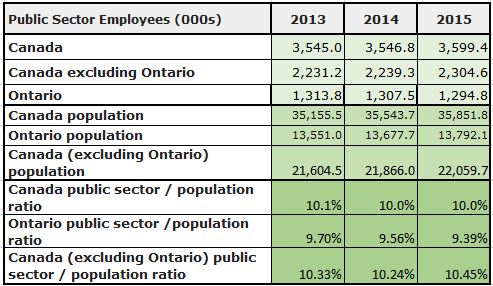 Sources: Statistics Canada, Labour Force Survey 282--0089 and Population by year and by province and territory
When you need a health care worker, this reality will come home to roost.

Maybe you should read this study - the Fraser Institutes numbers & findings do not match yours
ReplyDeletehttps://www.fraserinstitute.org/sites/default/files/analysis-of-public-and-private-sector-employment-trends-in-canada.pdf